Let’s be honest: kids are weird. One minute they’re attempting to launch themselves off the sofa like a stunt double for an action movie; the next, they’re refusing to walk because their socks “feel wrong.”
If you’ve been searching for fisioterapi kanak-kanak OKU or pediatric physiotherapy Malaysia for kids with disability, you’re likely looking for answers. You’re wondering how to bridge the gap between where your child is now and where they could be.
The good news? Movement is medicine, and we’re here to make it fun.
What Exactly is Physiotherapy for OKU Children?
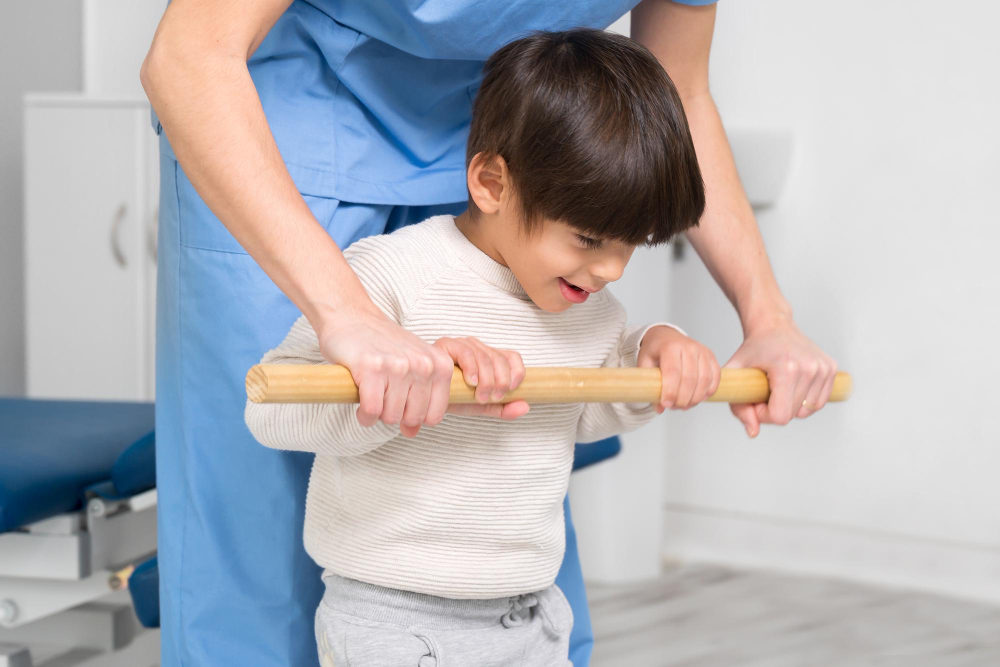
Physiotherapy for OKU children, or what some may call therapy for kids with disabilities isn’t about forcing a child to do boring reps of sit-ups. It’s a specialized form of care that focuses on the unique wiring of a growing child.
Whether it’s
- Improving balance
- Building muscle strength
- Teaching the body how to coordinate a step
Physiotherapy acts as the bridge between a child’s intention and their ability.
Think of it as teaching the brain and body to have a better conversation. For children with disabilities, that conversation sometimes has a bad signal. For our OKU kids, physiotherapy amplifies the signal, helping them gain the mobility they need to explore their world, because we all know that a child who can’t move freely is a child who gets frustrated.
Signs Your OKU Child May Need Physiotherapy
Kids do not come with instruction books, and they certainly do not come with a checklist of “normal.” But there are a few signs that it may be time to see a physiotherapy specialist for OKU children.
You might notice:
- Stiff muscles that are hard to stretch
- Low muscle tone, where your child feels like a floppy doll
- Delays in reaching milestones, such as: –
- Not sitting by 9 months
- Not walking by 18 months
- Walking on their toes all the time
If you see these signs, it is worth getting help. Starting early is important. The sooner we begin, the less time your child spends fighting with gravity.
Common Conditions We Help With
The beauty of TAGS pediatric rehab for kids is that it isn’t a one-size-fits-all approach. We see a wide spectrum of superheroes in the clinic, each with their own superpowers.
Common conditions we treat:
- Cerebral Palsy: We manage tight muscles, improve independence, and prevent stiff joints. Our goal is to keep muscles long and strong so they can move comfortably.
- Down Syndrome: With loose joints and low muscle tone, we focus on building stability and core strength to help with sitting, crawling, and eventually running.
- Torticollis: We help loosen those tight neck muscles to prevent flat head syndrome and help them turn their head freely.
- Prader-Willi Syndrome and Developmental Delays: We focus on weight-bearing activities and motor planning to build confidence and physical endurance.
Making Therapy Fun (Yes, Really)
If you think physiotherapy is just a cold room with a plinth and a timer, you’re doing it wrong. Here at TAGS, especially for children, it needs to look like a playdate, not a doctor’s appointment.
When a child is bouncing on a trampoline, they aren’t just bouncing, they are regulating their sensory system and building bone density. When they are crawling through a tunnel to grab a toy car, they aren’t just playing, they are strengthening their shoulders for handwriting and coordinating their limbs for walking.
This is play-based therapy. We use swings, obstacle courses, and even bubbles to trick kids into doing the hard work.
Why? Because you can’t negotiate with a toddler. You can’t say, “Darling, if you do three sets of hamstring stretches, I’ll give you a sticker.” But if you say, “Let’s race to the castle to save the dragon!” they will move mountains, and their hamstrings will stretch naturally in the process.
Supporting Parents at Home
Here is the reality. You are the therapist who lives with your child. I see them for an hour a week, you see them for 167 other hours. So, the most effective physiotherapy for kids with disabilities involves YOU.
We won’t ask you to become a medical expert, but we will ask you to become a “positioning pro.” Simple habits make a massive difference.
- During TV time: Instead of letting your child slump on the couch, try side-lying or propping them up on their elbows. This helps build upper body strength.
- Diaper changes: Gently extend your child’s legs for hamstring stretches to keep their muscles flexible.
- Floor time: Let your child move on the floor as much as possible. Walkers and swings are convenient, but the floor is where the real progress happens.
Long-Term Benefits of Physiotherapy for OKU Kids
The goal of physiotherapy for OKU children isn’t just to get them to walk by age three. It is to prevent the secondary complications that come with a sedentary lifestyle as they grow.
By keeping the body aligned and active, we can prevent scoliosis, manage chronic pain, and ensure that a child who uses a wheelchair has the upper body strength to push themselves around independently. Yes, we are maximizing independence.
The measure of success isn’t just how well they walk. It’s about maximizing their independence and improving their quality of life as they grow.
Ready to Get Your Child Moving?
Parenting a child with special needs is a long journey. Some days, progress feels slow. But we are here to help your child move and grow. Every child deserves a chance to move through the world on their own terms.
Physiotherapy for OKU children is now available at ALL TAGS branches. Whether you are in Kuala Lumpur, Selangor, Johor, Melaka, Penang, Kuching or anywhere with a TAGS near you, your child can get quality care.
Because every child deserves to thrive. And every parent deserves peace of mind.
Visit your nearest TAGS today. Your little one has places to go.
📲 Chat with us on WhatsApp: Click here to start a conversation.
Fast response. No obligation.